
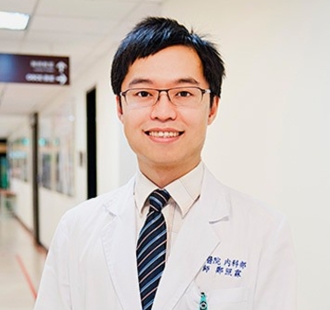


Research Interests
• General Internal Medicine and Gastrointestinal Diseases, Hepatobiliary and Pancreatic Diseases/Peptic Ulcer/Gastroesophageal Reflux Disease (GERD)/Gastrointestinal Tumors, Acute and Chronic Hepatitis, Liver Cirrhosis, and Hepatic Tumors, Procedures: Upper and Lower Gastrointestinal Endoscopy and Polypectomy, Abdominal Ultrasound, Endoscopic Ultrasound (EUS), Endoscopic Retrograde Cholangiopancreatography (ERCP), Placement of Duodenal and Colonic Metal Stents
Education Background
• MSc, Graduate Institute of Clinical Medicine, Taipei Medical University
• MD, School of Medicine, Taipei Medical University
Current Position
• Director, United Examination Center
• Attending Physician, Division of Gastroenterology
Professional Experience
• Clinical Research Fellow, Endoscopy Center, Department of Gastroenterology, National Taiwan University Hospital
• Resident, Department of Internal Medicine, Taipei Municipal Wanfang Hospital
• Chief Resident, Division of Gastroenterology, Taipei Municipal Wanfang Hospital
Gastrointestinal (GI) endoscopy has undergone remarkable transformation over the past decades, evolving from a diagnostic tool into a cornerstone of therapeutic intervention. The procedural complexity and patient expectations have grown, as well as the demands placed on anesthesia services. The dynamic interplay between gastroenterology and anesthesiology, tracing the historical trajectory of sedation practices in GI endoscopy—from minimal sedation in early diagnostic endoscopies to the current reliance on deep sedation and/or general anesthesia for advanced therapeutic procedures. Remarkably, the challenges posed by aging populations, comorbidities, and the rise of outpatient endoscopy centers in our country, all of which require a more nuanced and individualized approach to sedation. The interdisciplinary perspective offers a roadmap for clinicians, anesthesiologists, and healthcare systems to collaboratively shape the next era of patient-centered endoscopic care.